Share this article
Lessons on Sales, Early Adopters, and the Revenue Engine from Invest Ottawa’s IO Traction Program
Part 2 of the IO Traction Learning Series. Read Part 1: "Stop Building What Nobody Asked For" for the foundation on ICP and proto-persona validation.
Nobody Buys a Product. They Buy Relief.
Remember that scene in Jerry Maguire where Cuba Gooding Jr. keeps yelling, "Show me the money?” Every founder has that moment.

You built the thing.
You validated the persona. (If you read my first blog in this series, you met Adam, the proto-persona we built during the ICP session.)
Now comes the part that separates companies that survive from companies that become cautionary tales: selling.
But here’s the twist. Selling isn’t about showing people your product. It starts with showing people you understand their pain. The second IO Traction session at Invest Ottawa dove headfirst into this, and what came out changed how I think about initiating a sales call completely. The session covered everything from early adopter strategy to revenue engine funnels.
If the first session was about figuring out who your customer is, this one is about learning how to make that customer care.
The session was conducted by Jon Chatburn, Advisor, Coach, and Trainer at Growth Guide.
Lead with Pain, Not with Product
The session opened with a principle that is deceptively simple: when you are on a sales call or networking at an event, lead with your customer’s frustrations. Do not open with your product features. Do not open with your company story. Open with the specific pain point your customer experiences, and then let them vent.
This is the conversational equivalent of what Adele does in the first ten seconds of "Someone Like You." She doesn’t start with her feelings. She starts with the narration on what has happened to the person she’s talking to. It’s a reflection on the person’s life and not the singer’s, and suddenly, she shares her feelings and a genuine emotion is felt.
Sales works the same way. When you name a pain point that your prospect is living through, something clicks. They lean in. They feel understood. And that emotional bridge is far more powerful than any product demo.
Think how Slack grew in its early days. Stewart Butterfield did not pitch Slack as "a messaging tool with channels and integrations." He pitched it as the cure for email chaos. He named the frustration: your team is drowning in email threads, and nobody can find anything.
That framing made people say "yes, that is exactly my problem" before they even saw the product. The product became the answer to a question the customer was already asking.
The practical takeaway? Before your next call or networking conversation, write down the top three frustrations your proto-persona (going back to Adam from Blog 1) experiences daily. Start the conversation with one of those questions.
Let the other person rant.
Listen actively.
Ask questions to tap in more into the pain point, or bring another burning pain point.
You’ll notice a change in state in your prospect/lead.
Only when you have earned the right, do you connect your solution to what they just told you.
The First Five: Why Early Adopters Are Your Entire Strategy
One of the strongest takeaways from this session was the emphasis on early adopters.
Not hundreds of users. Not even fifty.
Five to ten people. Who are willing to try your ugly, incomplete, work-in-progress product and give you honest feedback. That small group is the ignition mechanism to your entire product-market fit strategy.
If you have watched The Breakfast Club (or Stranger Things), you know that five very different people locked in a room together can create something unexpected and powerful. Your early adopter group works the same way. They aren’t there because your product is polished. They aren’t there because you’re a nice guy and they like you.
They are there because they feel the pain so deeply that they will tolerate an imperfect solution to get relief. The reward of the full solution is so high for them that they will tell you what feature they want next.
That back and forth communication is your signal that you are solving a real problem.
Dropbox is the textbook example here. Before they had a working product, Drew Houston created a simple demo video showing what Dropbox would do. That video attracted a waitlist of 75,000 people overnight. But that isn’t the only piece of the puzzle. Dropbox had an invite-only beta primarily because they were unsure how much usage their servers could handle. They were learning from this beta group consistently to improve their product.
So should founders with MVPs.
Without that base of five to ten early adopters, you are building in a vacuum. You might remember from the first blog how we built the proto-persona Adam to get specific about who we are targeting. Early adopters are the real-world Adams who tell you if they prefer an orange over an apple. They are the ones who validate whether your hypothesis was right or whether you need to go back and iterate. Like roots growing beneath the surface of the soil, they do the invisible work that eventually supports everything above.
What Makes a Good Early Adopter?
- They experience the pain point you are solving at a high frequency
- They are willing to tolerate an imperfect product in exchange for early access
- They will give you honest, detailed feedback (not just polite compliments)
- They have enough influence or credibility that their endorsement carries weight later
- They represent your ICP closely enough that their behavior predicts broader market behavior
The Ugly Duckling MVP: Why Looking Bad Is a Good Sign
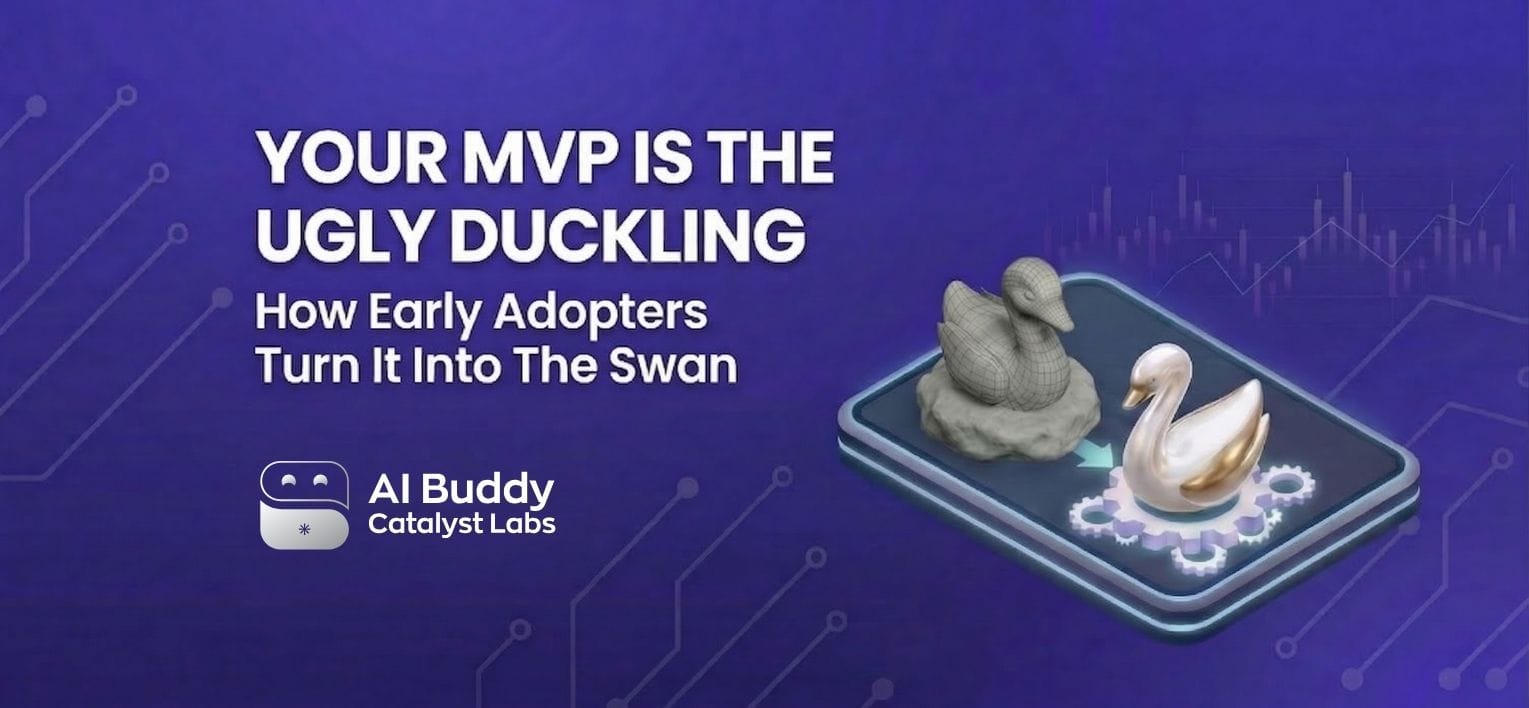
One of my favorite moments in the session was the ugly duckling analogy for MVPs. Your minimum viable product is not supposed to be beautiful. It is not supposed to be complete. It is supposed to be just functional enough that a real user can interact with it and tell you what matters. And what sucks.
Think about the first iPhone in 2007. It could not copy and paste text. It had no App Store. It could not send MMS messages. By today’s standards, it was shockingly limited. But it solved a core problem so well that early adopters forgave everything else.
Apple did not try to ship every feature on day one. They shipped the minimum that mattered and then iterated relentlessly based on what users actually needed.
Or think about it through the lens of The Karate Kid. Daniel LaRusso does not start by fighting in the tournament. He starts by waxing cars and painting fences. Those ugly, repetitive, seemingly pointless exercises are the training. Your MVP is the wax-on, wax-off phase. It looks like nothing, but it is teaching you everything you need to compete later.

The session reinforced that the MVP is the ugly duckling. It does not look good. People might even laugh at it. But with each round of user feedback, each iteration, each fix based on real customer behavior, it transforms.
Eventually, in the quest for Product-Market-Fit (PMF), it becomes the swan. The founders who accept this and embrace the ugly phase are the ones who build products that last.
The Pilot Program: Structure Builds Trust
Here is something the trainer emphasized multiple times: your beta users and pilot participants need to see structure. When you invite someone to test your product, you are asking them to invest their time, attention, data, and trust. If your pilot program looks thrown together, they will treat it that way.
The pilot program needs clearly detailed steps. Participants should see a timeline, know what is expected of them at each stage, understand what feedback you need, and feel like they are joining a real program, not a random experiment. This is the difference between someone thinking "this founder has their act together" and someone thinking "I am being used as a guinea pig."
Amazon’s approach to internal pilots is a strong parallel. Before launching a new service to customers, Amazon teams write a press release and FAQ document for a product that does not exist yet. This is their famous "working backwards" method.
The structure of that internal document, who is the customer, what is the problem, why is this solution better, forces clarity before a single line of code is written. Your pilot program should do the same for your beta users. If you cannot explain the program clearly on one page, it is not ready.
The Revenue Engine: From Promise to Advocacy
The session introduced a concept that reframes how you think about your entire business: the Revenue Engine Funnel. This is not your typical marketing funnel. It stretches from the promise of value all the way to the delivery of value, moving through awareness, consideration, conversion, retention, and ultimately advocacy.
Most founders obsess over the top of the funnel. They pour money into ads, content, and awareness campaigns. But the real compounding money, sustainable kind, comes from referrals, advocacy, word of mouth.
And that lies at the bottom of the funnel.
This is where your customers become your sales team. It is where a satisfied user tells three colleagues, posts about you on LinkedIn, or recommends you in a community. That is the Bohemian Rhapsody effect: Queen did not get a traditional radio push with a nearly 6 minutes long song with no chorus. But their song was so good that listeners started requesting it.
Listeners became the marketing engine.
The Journey from MVP to Scale-Up
The session mapped out a clear progression that every startup moves through, and each stage has a distinct learning objective. Here is how it breaks down:

Caption: One lucky shot isn’t enough to get to PMF.
MVP to Product-Market Fit is the phase where you are figuring out what people will actually pay for. Your revenue is small, maybe inconsistent, but it exists. You are learning to price. This is where Adam from Blog 1 lives. He is your hypothesis, and every dollar of revenue either confirms or challenges that hypothesis.
Product-Market Fit to Go-to-Market is the high customer acquisition cost phase. You have proven that people will pay. Now you need to learn how to sell consistently. This is where you figure out your repeatable sales motion, your messaging, your objection handling, and your closing process. You are scaling what works and cutting what does not.
Go-to-Market to Scale-Up is when you have cracked the code and now you need to grow the machine. This is the hockey stick growth phase that investors love to see. But you only get here by doing the painful, unglamorous work of the first two stages.
Build, Measure, Learn: The Lean Loop That Catches the Drop-Off
The Lean Startup model of build-measure-learn came up as a foundational concept. The cycle is simple:
- Build something
- Measure how users interact with it
- Learn from the data
Loop back around. What makes it powerful is the discipline of actually looking at where customers are dropping off instead of assuming everything is fine.
Jon, the trainer, shared a story from his own sales experience that made this concrete. His company had a product that required an iPad for the end user. The company was supplying iPads to clients, but usage numbers were terrible. People were not using the product at all. When they investigated, they discovered the iPads were either never delivered to the right person or were sitting unopened in a supply closet. Jon’s team started tracking who received the device, and faced challenges in having it handed to the right person and completing the onboarding. People didn’t want to share their personal emails, some didn’t want to create a new Apple ID, and many other problems popped up.
Once the team identified this onboarding gap, they built a structured onboarding program. They actively walked each user through setup, confirmed the device was in the right hands, and tracked activation personally. That hands-on process moved users from "I received a box I did not ask for" to genuine product adoption. Over time, as the process matured, users moved from adoption to retention organically.
This is the same lesson Netflix learned in its early streaming days. They noticed users were signing up but not watching anything in the first week. The drop-off was not about content quality. It was about the recommendation engine. When Netflix improved personalized suggestions during the first session, retention jumped dramatically.
The product was fine.
The onboarding experience was the bottleneck.
When that was removed, adoption increased.
The takeaway for founders: do not just measure signups. Measure what happens after the signup. Where does the user stall? Where do they disappear? That is where your biggest growth opportunities are hiding.
The Feedback Iceberg: Show the Tip, Do the Work Below
The session touched on a powerful metaphor for managing feedback and stakeholder communication: the iceberg model. Your customers and shareholders do not need to see everything happening inside your company. They need to see the polished tip. The clean interface. The progress update. The milestone reached.
Below the waterline, your team is dealing with bug fixes, infrastructure decisions, internal debates, failed experiments, and late-night problem solving. That is normal. That is healthy. But exposing all of that complexity to external stakeholders creates confusion, not confidence.
Think of it like a movie set. The audience sees the finished scene. They do not need to see the forty takes, the broken prop, and the director arguing with the cinematographer.

Caption: what the audience sees
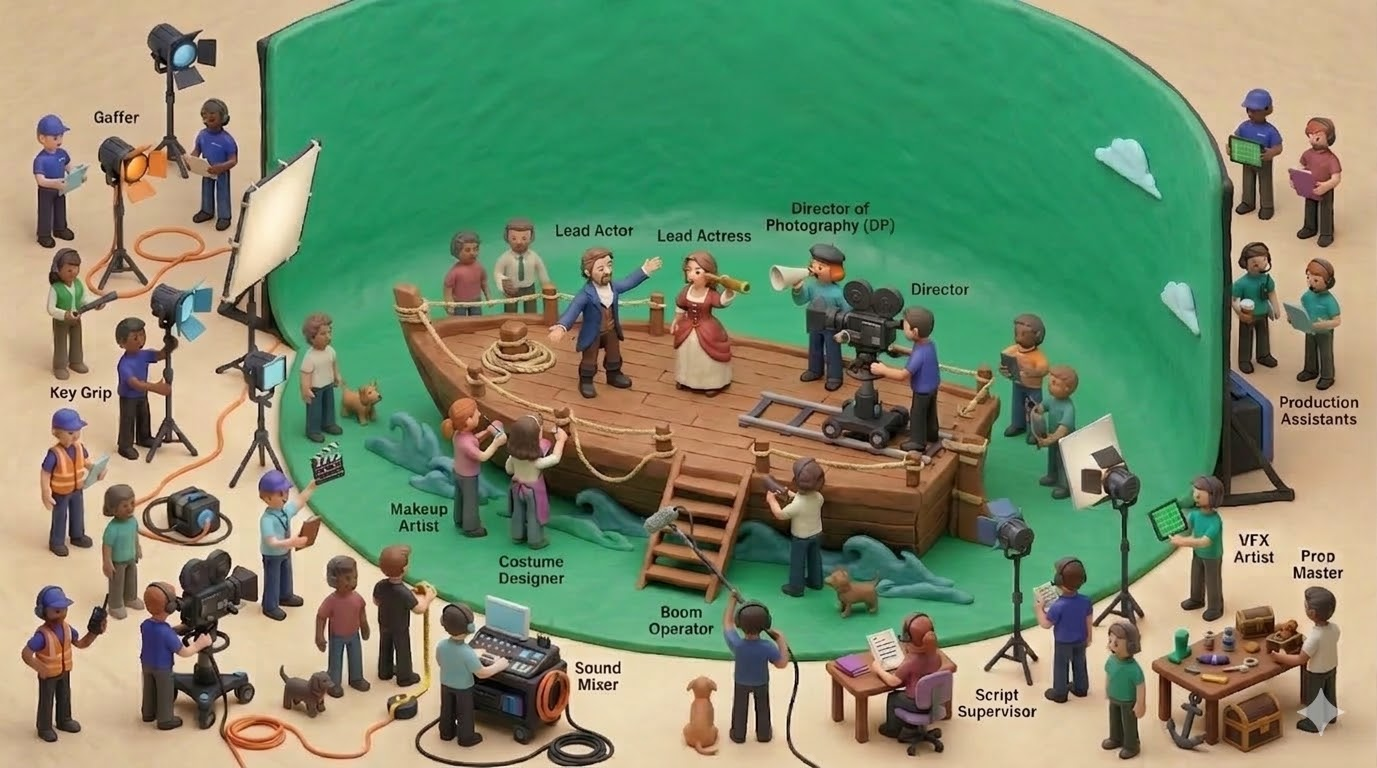
Caption: what goes on behind the scenes to make it happen
Internally, however, the session emphasized the value of shareholder value mapping. This means understanding what each internal stakeholder cares about and ensuring they have visibility into the parts of the operation that matter to them. Your CTO needs different information than your investors, who need different information than your early adopter community.
The feedback loop also works in both directions. When you collect feedback from customers, that process itself becomes an educational tool. Customers learn how to articulate what they need. Your team learns what to prioritize. Both sides get sharper with each cycle. Feedback is not just data collection. It is a relationship-building engine that teaches everyone involved.
MQLs, SQLs, and the People Who Close Deals
The session also covered (a LOT was covered that day on sales) the sales pipeline structure, specifically the distinction between Marketing Qualified Leads (MQLs), Sales Qualified Leads (SQLs), active deals, and buyers. Each stage represents a different level of intent and readiness, and each stage benefits from a different type of human interaction.
Think of it like a relay race in the Olympics. The first runner (your appointment setter) gets the baton moving. Their job is to qualify interest, book the meeting, and get the prospect to the table. The second runner (your closer) takes over with product knowledge, objection handling, and the ability to get to "yes." In larger organizations, there is often a third runner: the account executive or relationship manager who ensures the client stays engaged, renews their subscription, and grows their usage over time.
Breaking Down the Roles
- Appointment Setters (SDRs/BDRs): These are your prospectors. They make outbound calls, send cold emails, and do the initial qualifying. Their job is not to sell. Their job is to open doors and book meetings for the closers. Think of them as the casting directors who find the right actors, not the ones who direct the movie.
- Closers (Account Executives): These people run the demos, handle objections, negotiate pricing, and get the contract signed. They are the ones who turn a curious lead into a paying customer. In startup terms, this might be you, the founder, for the first fifty deals. And that is fine. Founders should be closing early deals because it teaches you your own product and market better than any dashboard ever could.
- Relationship Managers (CSMs/AEs for Retention): In larger organizations, these are the people who ensure annual renewals, identify upsell opportunities, and maintain the client relationship after the deal is signed. They are the reason a one-time buyer becomes a lifelong advocate. Without them, you have a leaky bucket.
For early-stage founders, you are often all three of these people at once (no wonder why early founders could grow some form of ADHD). But understanding the separation helps you decide which role you need to play with which client. Also, you know when to hire for each role as you scale.
Connecting the Dots: From ICP to Revenue Engine
If you have been following this series, you will see how each session builds on the last. In Blog 1, we defined who we are selling to (the ICP and proto-persona). In this session, we learned how to sell to them. The Hypothesis-Persona Map gave us Adam. The sales session gave us the playbook for reaching Adam, earning his trust, and converting him into a paying customer. In the next blog, we take a deep dive into marketing.
Going forward, the challenge for founders (including me) is to keep these connected. Every iteration on the proto-persona should inform the sales pitch. Every sales conversation should feed back into the ICP validation. The build-measure-learn loop does not just apply to product. It applies to your entire go-to-market engine.
What’s Coming Next
This is Part 2 of the Invest Ottawa Traction Learning Series. Future installments will cover go-to-market execution frameworks as I continue through the Program. Follow along if you are building something and want real, unfiltered lessons from the trenches.
Conclusion
The biggest lesson from this session is that sales is not a pitch. It is a process of understanding pain, earning trust with a small group of early believers, and building a revenue engine that compounds over time. Your MVP will be ugly, your first pilot will be imperfect, and your sales motion will feel clumsy at first. That is the point. The founders who embrace the awkward, iterative, deeply human work of selling to real people are the ones who eventually get to scale. Everything else is just a prettier way to guess.

Sohan Haidear
Strategic growth expert with 15+ years of experience across Fortune 500 companies and startups. Specializes in fractional CMO services, helping businesses scale with AI-powered marketing and automation.